
Stars and Stripes Forever!
Jerome Robbins’ Fancy Free
George Balanchine’s Who Cares? (Concert Version)
Eliot Feld’s Variations on ‘America’
George Balanchine’s Stars and Stripes
This dynamic mixed bill showcases the energy, creativity, and spirit of American ballet through works by Jerome Robbins, George Balanchine, and Eliot Feld. From Robbins’ vibrant Fancy Free to Balanchine’s jazzy Who Cares? (Concert Version) and patriotic Stars and Stripes, as well as Feld’s bold Variations on ‘America,’ the program celebrates the richness of American movement, music, and history.
Art-Reach ACCESS tickets will be available in two phases: the first release on July 14, 2026, and the second release will be on Thursday, August 27, 2026 (six weeks before the opening night). To participate in the ACCESS Program, patrons must pick up their tickets at the Academy of Music box office and present a valid ACCESS card. ACCESS tickets can be purchased online using a promo code, by calling the Box Office at 215.893.1999, or in person at the Box Office window.
Philadelphia Ballet is proud to partner with GOVX to offer verified members exclusive savings throughout the season. Click here to learn more.
Philadelphia Ballet gratefully acknowledges the Sponsors for Stars and Stripes Forever!
Koichi Tasa and Bill Walker
Run times:
Fancy Free: 34 minutes
15 minute intermission
Variations on ‘America’: 8 minutes
Who Cares (Concert Version): 25 minutes
15 minute intermission
Stars and Stripes: 34 minutes
Performances By Date
*Military, Veterans & First Responders Night
Military members, veterans, and first responders receive 40% off tickets to this performance. Use promo code PBMVFR at checkout to redeem the discount.
Fancy Free was the precursor to the Broadway musical On the Town, depicting three sailors enjoying their Manhattan shore leave.
In 1944, the young Jerome Robbins, in collaboration with composer Leonard Bernstein, created his first ballet, Fancy Free–a fresh, unmistakably American work that captured the spirit of wartime New York City. The ballet’s success led to the hit musical On the Town and later to another iconic Robbins–Bernstein collaboration, West Side Story. Fancy Free launched Robbins’s choreographic career, revealing his gift for vivid storytelling, inventive movement, and a uniquely American style.

Jerome Robbins is world renowned for his work as a choreographer of ballets as well as his work as a director and choreographer in theater, movies and television. His Broadway shows include On the Town, Billion Dollar Baby, High Button Shoes, West Side Story, The King and I, Gypsy, Peter Pan, Miss Liberty, Call Me Madam, and Fiddler on the Roof. His last Broadway production in 1989, Jerome Robbins’ Broadway, won six Tony Awards including Best Musical and Best Director.

Any single aspect of Leonard Bernstein’s (August 25, 1918- October 14, 1990) musical life is a complete story unto itself. Born to Ukrainian-Jewish immigrants, Bernstein was raised in the Lawrence, MA. With only mild encouragement from his family, Bernstein took up piano and composition as a child and studied both while at Harvard. At the Curtis Institute of Music, Bernstein added conducting his musical studies. Bernstein’s storied rise to conducting superstardom did not end his astonishing productivity as a pianist, educator, or composer. He wrote just about every genre of music, including symphonic, choral, vocal, piano, chamber music, film, ballet and, most famously, musical theater.
– Beatrice Jona Affron
Composer George Gershwin’s melodies provide the foundation for George Balanchine’s lively choreography.
In 1970, over three decades after their first creative collaboration (Goldwyn Follies in 1938), Balanchine created Who Cares?, set to sixteen Gershwin standards written between 1924 and 1931 and orchestrated by Hershy Kay. This choreography captures an American spirit that celebrates the vibrancy and energy of urban life.
The Company will perform the Concert Version of this work, which is comprised of the pas de deux and solos.

It is difficult to overstate the depth and breadth of the artistry and influence of choreographer George Balanchine. Called the ‘Father of American Ballet,’ he combined a reverence for the classical training he received as a boy in St. Petersburg with ferocious originality and commitment to modernism. He and his many brilliant collaborators, including Sergei Diaghilev, Igor Stravinsky, Georges Rouault, and Karinska, among many, many others, transformed ballet into a 20th century artform. Balanchine’s influence as a teacher is every bit as paradigm-changing as the repertoire he created. When our own founder, Barbara Weisberger (herself a protégée of Balanchine) conceived of Philadelphia Ballet, Balanchine insisted, “But first, a school.”
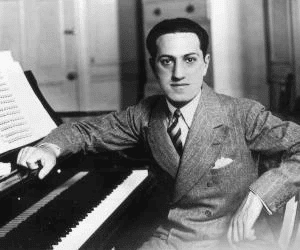
George Gershwin (born Jacob Gershwine) was born in New York City, the second of four children of Eastern European Jewish immigrants. He spent most of his childhood on the Lower East Side, also known then as the Yiddish Theater District. At ten years old, Gershwin fell in love with the piano and began to study seriously. At fifteen, he quit school to become a song plugger on Tin Pan Alley and at twenty, he composed his first national hit “Swanee”, made famous by Al Jolson.
In the next eighteen years, George Gershwin led a life of dizzying productivity while at the same time setting an enduring standard for crossover artistry with works like Rhapsody in Blue and An American in Paris, in which he showed how jazz and classical idioms could be combined. Numerous Broadway shows followed, many composed in collaboration with his lyricist brother, Ira. Perhaps his most ambitious and problematic work was the opera, Porgy and Bess (1935). After the commercial failure of this tour de force, Gershwin and his wife, Leonore, moved to Hollywood. George went right to work writing wonderful songs for Shall We Dance (1936) starring Fred Astaire and Ginger Rogers. Tragically, Gershwin became ill shortly after the film’s premiere. He was only 38 when he died of brain cancer, diagnosed years too late. George Gershwin left behind a cherished collection of songs and instrumental works that make up one of the pillars of American music.
– Beatrice Jona Affron
Eliot Feld’s Variations on ‘America’ pairs patriotic imagery with classical ballet, pushing the boundaries of the genre with modern movement.
Set to the distinctly American sounds of Charles Ives and orchestral arrangements by William Schuman, Eliot Feld’s Variations on ‘America’ unfolds as a commentary on American identity. Costumes, flags, march‑like rhythms, and athletic virtuosity combine in a kaleidoscopic portrait of America.

Eliot Feld began his education at Yeshiva before transferring to public school and starting dance training at age eight with modern dancer Ronne Aul. At eleven, Feld was accepted into the School of American Ballet and soon performed as the Child Prince in the premiere season of George Balanchine’s The Nutcracker with New York City Ballet. He studied with many renowned teachers and attended the High School of Performing Arts.
At sixteen, Feld joined the Broadway cast of West Side Story, later appearing in the film version, as well as I Can Get It for You Wholesale and Fiddler on the Roof. He joined American Ballet Theatre in 1963, becoming a principal dancer in 1968 and debuting as a choreographer in 1967. Feld later founded several companies, choreographed over 100 ballets, established Ballet Tech and the Joyce Theater, and remains a major figure in American dance.

Charles Ives (October 20, 1874 – May 19, 1954) was one of the most singular American composers of the 20th century. Born in Danbury, CT, he was particularly close with his father, a businessman and veteran Civil War bandleader. Charles studied piano as a young child and soon developed a fascination with the organ, which he began to play professionally at only 14 years old. At around the same time, Ives began to compose little marches and circus tunes, inspired by the music around him. This would be the foundation of his later work; the hallmark of Ives’s music is his way of combining separate and unrelated melodies, such as the sound of a parade as it walks past a church while a hymn is being sung. After graduating from Yale with a degree in music, Ives heeded his father’s advice and moved to New York City to start a career in business. Establishing a successful insurance firm did not slow down his astonishing musical output. But at only 44 years old, Ives suffered a heart attack lived in retirement for the last third of his life.
– Beatrice Jona Affron

William Schuman (August 4, 1910 – February 15, 1992) was born and raised in New York City. He played violin and banjo as a child, but his first real love was baseball. (He would go on to compose the opera, The Mighty Casey, based on “Casey at the Bat”). Schuman studied business at NYU, but after writing a song with lyricist Frank Loesser, and after attending his first symphony concert, conducted by Arturo Toscanini, Schuman decided to change course and study music. Schuman won the inaugural Pulitzer Prize for music and went on to compose a large catalog of symphonic, vocal, chamber and theatrical works, including Night Journey for Martha Graham. Schuman served as president of the Juilliard School in 1945 to 1961, when he became the president of Lincoln Center.
– Beatrice Jona Affron
George Balanchine’s Stars and Stripes combines exuberant patriotism with the sheer technical brilliance and richness of a full-length classical ballet.
George Balanchine’s high-spirited Stars and Stripes, set to the spirited marches of John Philip Sousa, bursts with color, precision, and patriotic energy. Divided into five “campaigns,” each of which features a different Sousa march, this dazzling work showcases Balanchine’s wit and brilliance as well as his immense pride in becoming an American citizen.
George Balanchine’s high-spirited Stars and Stripes, set to the spirited marches of John Philip Sousa, bursts with color, precision, and patriotic energy. Divided into five “campaigns,” each of which features a different Sousa march, this dazzling work showcases Balanchine’s wit and brilliance as well as his immense pride in becoming an American citizen.

John Philip Sousa, also known as the “American March King” was a prolific composer of marches and operettas. Next to the flag itself, Sousa’s music is perhaps the most recognized symbol of American patriotism. In 1987, by act of the U.S. congress, Sousa’s “The Stars and Stripes Forever” was designated the national march of the United States.
– Beatrice Jona Affron

Hershy Kay was born in Philadelphia and studied composition under Randall Thompson at the Curtis Institute of Music. Kay was a friend and classmate of Leonard Bernstein, who engaged him early on to orchestrate his musical, On the Town. This was the beginning of a busy career as a Broadway orchestrator and as a composer in his own right. Kay composed and orchestrated no fewer than seven works for New York City Ballet, including Western Symphony, Tarantella, Who Cares?, and Stars and Stripes.
– Beatrice Jona Affron